
How Much Does It Cost To Build A House In Portland, Maine in 2026?

Date Last Modified:
03/04/2026
What are the actual Portland, Maine Construction Costs Per Square Foot in 2026?
Building a house in Portland, Maine costs between $270 and $400+ per square foot in 2026, depending on finish level, site conditions, and material choices. This is a turnkey cost that covers everything except the land, from site work through certificate of occupancy; architectural plans and permits are additional.
This guide breaks down what it actually costs to build a house in Portland — including materials, labor, permitting, neighborhood factors, and the hidden costs most estimates leave out.
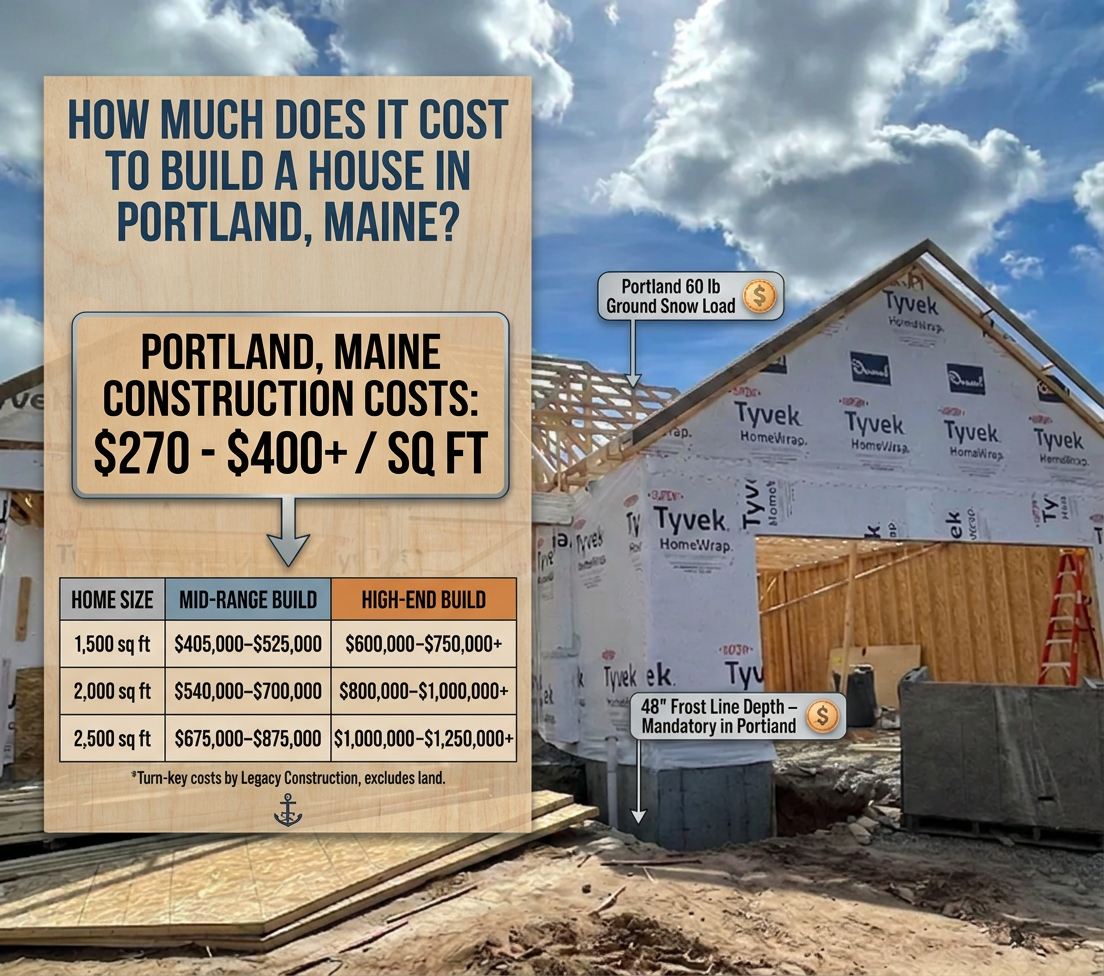
| Home Size | Mid-Range Build | High-End Build |
|---|---|---|
| 1,500 sq ft | $405,000–$525,000 | $600,000–$750,000+ |
| 2,000 sq ft | $540,000–$700,000 | $800,000–$1,000,000+ |
| 2,500 sq ft | $675,000–$875,000 | $1,000,000–$1,250,000+ |
Those numbers are turn-key figures from our Portland job sites here at Legacy Construction, an expert custom home builder in Portland, ME.
For context, the NAHB's 2024 Survey of Construction found that custom homes in New England carried a median price of $190 per square foot — the highest region in the country — before land costs.
Portland's tighter lots, 48-inch frost depth, and compressed building season push well above that regional median.
These costs cover everything from site work and excavation through final finishes — lot clearing, gravel driveway, and all construction through certificate of occupancy. The only thing not included is land.
That’s worth saying again because most cost-per-square-foot figures floating around the internet don’t mean the same thing. When we quote a number, the client walks into a finished, move-in-ready home on the day they close with us.
Portland runs roughly 12–15% higher than other Maine markets like Augusta, Waterville, and Lewiston.
Portland's median listing price commands a 50% premium over the statewide median (HousingWire, Dec 2025), and that pricing pressure extends to construction labor and materials. At $356 per square foot for existing homes — 40% above the state average — the cost environment for new construction follows suit.
If you’re researching the cost per square foot to build a house in Maine, understand that the number changes significantly depending on where in the state you’re building.
The figures in this guide are specific to Portland and Southern Maine.
The reasons are structural. Labor demand is higher here. The construction season is compressed. Lots are tight. And the permitting process takes longer than in most of the state.
We’ve been building custom homes across Portland and Southern Maine since 2021, and our founder, Joe, spent 15 years managing commercial projects — developments up to $300 million — before returning to residential work.
That background is why our work as a general contractor in Portland, Maine starts with a real estimate, not a ballpark guess pulled from a national average.
An accurate cost breakdown requires knowing your lot, your floor plan, and your finish expectations. If you’re planning a Portland build and want numbers tied to your actual scope, fill out our estimate form, and we’ll be in touch.
Why Portland Construction Costs More Than the Rest of Maine
The per-square-foot range above isn’t arbitrary. Every dollar of that Portland premium traces back to something specific — labor, lot conditions, demolition, frost depth, or the permitting timeline. Here’s what actually drives it.
Labor Rates and Contractor Availability
Southern Maine’s construction labor market is tight. Quality subcontractors — framers, electricians, plumbers, finish carpenters — are booking at least 2–4 months out on residential work.
This tracks with statewide data. According to the Maine Department of Labor, 41% of the state's current carpenters are expected to retire within the next decade, and specialty trade contractors in Maine average just five workers per firm — among the smallest payrolls in the nation (Home Builders Institute, Fall 2025 Construction Labor Market Report).
In early 2026, the Maine Community College System launched a Construction Industry Workforce Partnership specifically to address these shortages across Southern Maine.
By the time a homeowner has land and permits lined up, the sub-schedule is already a pacing constraint.
Portland labor runs higher than Central Maine — and the state's own data confirms it.
The Maine Department of Labor has consistently reported that hourly earnings in the Portland–South Portland metro are above the statewide average, while the Lewiston-Auburn and Bangor metros fall below it (Maine DOL Employment Situation reports, 2025).
On our projects, the gap typically ranges from 10–15% when comparing bids across markets for the same scope of work.
Urban Build Conditions & Historic Districts
Most available Portland lots are not clean greenfield parcels.
You’re typically dealing with a tight in-city lot — 3,000 to 6,000 square feet on the peninsula, limited truck access, no room for a material yard, and neighbors on both sides.
Munjoy Hill, East Bayside, the West End — these are narrow streets, shared lot lines, and in many cases, historic district adjacency that affects what you can do with the exterior.
These conditions reduce crew efficiency and increase scheduling complexity. Both show up in the cost.
Demolition as a Line Item
This is one of the most overlooked costs in a Portland build. Very few available lots in the city come without a structure already on them. Teardown is often part of the project, not a footnote.
Demolition typically runs about 10% of the total construction cost. On a $700,000 build, budget roughly $70,000 for demo before any new work begins.
If the existing structure sits in a historic district — Munjoy Hill Historic District, West End Historic District — demolition requires a Certificate of Appropriateness review.
Structures classified as “contributing” are generally not approved for demolition. That affects your lot options before you ever break ground.
Portland’s 48-Inch Frost Line
Portland, Maine’s frost line is 48 inches (4 feet) below grade, requiring all footings and foundations to extend to that depth per Maine building code.
All exterior footings in Portland must extend four feet underground. Every deck, addition, garage, and outbuilding on the project is subject to this — not just the main foundation.
That’s deeper than Boston at roughly 36 inches. It’s much deeper than anything south of New England. It adds real money to foundation work, and it’s not negotiable. It’s code.
In certain parts of Portland, ledge rock adds another layer. Munjoy Hill and Bramhall Hill are the most common encounters. Blasting or hydraulic rock-breaking can add $10,000 to $50,000+ to a foundation budget if you hit it.
A geotechnical investigation before you buy a Portland lot is money well spent.
Permitting Timeline and Fees
New construction in Portland, Maine requires a general building permit, plumbing, electrical, HVAC, and a minor site plan application at $300. If the project falls within a historic district, add a historic review and 2–4 additional weeks.
Plan review for new construction runs 4–8 weeks. Full permitting for a new build in Portland is typically a 2–3-month process before a shovel hits the ground.
Permit fees alone on a $700,000 home run approximately $10,000 or more.
Per the City of Portland Permitting and Inspections Department fee schedule (revised April 2025), the general building permit is $25 for the first $1,000 of work plus $15 per additional $1,000 — that's $10,510 on a $700,000 build before adding HVAC, electrical, plumbing permits, the $300 minor site plan application, and the $100 certificate of occupancy inspection.
These are fixed costs that don't move regardless of who you hire.
Portland Home Construction Cost Breakdown by Material
The $270–$400+ per square foot range isn’t vague. It’s driven by specific material decisions — siding, roofing, windows, kitchen finishes, bathroom finishes, flooring, and whether you’re building a garage.
Every sub-section below breaks down what those choices actually cost on Portland job sites. Not national averages. Not last year’s numbers. This is what we’re seeing on bids and invoices in Southern Maine right now.
This is the section that separates a $320/sq ft build from a $390/sq ft build before you change a single line on the floor plan.
Siding Costs in Portland
Siding is one of the first things a homeowner notices on a finished build. It’s also one of the widest cost ranges in the budget.
Portland’s coastal climate — salt air, rain that freezes and thaws through the winter, wind-driven moisture — makes material selection more than cosmetic. What you put on the exterior has to hold up here.
All prices below are per square (100 sq ft of wall coverage), installed:
| Siding Type | Cost Per Square (Installed) | Notes |
|---|---|---|
| Vinyl siding | $160–$200/sq | Lowest cost. Functional and low-maintenance. Common on builder-grade Portland homes — meaning homes built to a standard, no-frills spec rather than customized. Limited color depth and profile options compared to wood products. |
| Engineered wood siding (like LP SmartSide) | $270–$340/sq | Strong mid-range option. LP SmartSide is the most common engineered wood product we install — it comes from the factory already coated with primer (the base layer before paint), so it's ready to paint on-site. Good impact resistance. |
| Wood clapboard siding | $300–$400/sq | Traditional Maine look. Cedar or pine. Requires paint or stain maintenance on a 5–7 year cycle in Portland's climate. Historic district projects on the peninsula often require or strongly favor real wood clapboard. |
| Wood shingle siding | $800–$1,200/sq | Premium product. Cedar shingles are the classic coastal New England exterior. Labor-intensive — each shingle is hand-placed. Beautiful on the right house, but a significant line item. |
Here’s where that table becomes real money.
On a 2,000 sq ft home with roughly 2,800 sq ft of wall area (28 squares), wood shingle siding runs $19,200–$33,600. Vinyl on the same house runs $4,480–$5,600.
That’s a $15,000–$28,000 difference from a single material decision — and siding is just one line item. Stack it with roofing, windows, and interior finishes and those individual choices compound fast.
The trade-offs aren’t just about budget. A homeowner building on Munjoy Hill next to a historic district has different constraints than someone building in North Deering.
The peninsula may push you toward wood clapboard whether you planned on it or not. Off-peninsula, the full range of options is on the table.
Roofing Costs in Portland
Maine’s snow and coastal weather mean the roof takes a beating.
Portland has what’s called a 60-pound ground snow load. Here’s what that means in plain English: during the worst winter, the code assumes 60 pounds of snow could be sitting on every single square foot of ground.
Your roof and the wood frame holding it up have to be built strong enough to carry that weight without bending or breaking.
Why does this matter for cost? A stronger roof needs heavier lumber, more connections, and more labor to frame. That’s baked into every Portland build whether you choose cheap shingles or premium metal.
Material choice on top of that framing affects the initial cost and how many years before you’re paying for a new roof.
All prices are per square (100 sq ft of roof area), installed:
| Roofing Type | Cost Per Square (Installed) | Lifespan | Notes |
|---|---|---|---|
| Asphalt shingles | $200–$300/sq | 20–30 years | The standard choice. Modern architectural shingles go on almost every new home today. Most common on builder-grade and mid-range builds. |
| Screw-down metal roofing | $300–$400/sq | 30–40 years | Metal panels attached with screws through the face. Good at shedding snow. Each screw has a small rubber gasket that can wear out after 15–20 years. Solid mid-range choice. |
| Standing seam metal roofing | $450–$600/sq | 40–60+ years | Premium metal option. Panels lock together at raised seams — no screws visible on the surface. Best snow-shedding performance and longest lifespan. Most common on high-end custom builds in Portland. |
A typical 2,000 sq ft home has roughly 1,200–1,500 sq ft of roof area depending on how steep the roof is and how far it extends past the walls.
On a home with 1,400 sq ft of roof area (14 squares), asphalt runs $2,800–$4,200. Screw-down metal runs $4,200–$5,600. Standing seam runs $6,300–$8,400.
Standing seam adds roughly $3,500–$4,200 over asphalt on that same house. Not the biggest single line item in the budget — but the roof may outlast the mortgage, and that math matters over 30 years.
Pick based on how long you plan to own the home and how much you want to think about the roof after it’s on.
Window Costs in Portland
Portland falls in what building codes call Climate Zone 6A — one of the colder zones in the country. Because of that, the energy code requires windows that meet a minimum insulation standard (a U-factor of 0.30 or lower — the lower the number, the better the window holds heat inside your home).
That rules out the cheapest single-pane or low-grade options automatically. The baseline here is already a quality double-pane unit. The question is how far above that baseline you want to go.
| Window Type | Cost Per Window (Installed) | Notes |
|---|---|---|
| Vinyl windows (like Mathews Brothers) | $400–$700/window | Mathews Brothers is a Maine-based manufacturer — locally made, solid warranty, and the most common vinyl window we install in Portland. Meets Portland's energy code. A strong value choice on builder-grade and mid-range builds. |
| Fiberglass or wood windows (like Marvin& Andersen) | $700–$1,200/window | Premium products. Better insulation, more options for custom sizes and decorative details. The most popular setup for high-end builds is a real wood frame on the inside with a fiberglass or aluminum shell on the outside. |
A typical 2,000 sq ft home has 18–25 windows.
At the vinyl level, that’s $7,200–$17,500 in windows. At the premium level, that’s $12,600–$30,000.
A $15,000–$20,000 swing on windows alone is common between a mid-range and high-end Portland build.
Custom-size windows push costs further. A wall of floor-to-ceiling units facing Casco Bay is a real request we get — and a real line item, especially when those are custom-sized Marvin units at the upper end of the range.
Kitchen Remodel and Build Costs
The kitchen is where material choices compound fastest. Countertops, cabinets, appliances, tile, plumbing fixtures, lighting — every surface and every fitting has a cost range, and they all stack on top of each other.
Countertop options:
| Countertop Material | Cost Range (Installed) | Notes |
|---|---|---|
| Laminate | $15–$30/sq ft | Budget option. Functional, wide color selection, easy to replace down the road. Common in builder-grade kitchens and rental-oriented builds. |
| Granite | $40–$80/sq ft | Natural stone. Durable, heat-resistant, each slab is unique. Mid-range to high-end depending on the stone selected. Very common in Portland custom homes. |
| Quartz | $50–$100/sq ft | Engineered stone. Consistent color and pattern. No sealing or special maintenance required. Extremely durable. The most popular countertop choice in Portland custom builds right now. |
Cabinet options:
| Cabinet Type | What It Means for the Budget |
|---|---|
| MDF cabinets (painted) | Lowest cost option. MDF stands for medium-density fiberboard — it's made from wood fibers pressed together into a smooth, flat board. Takes paint well but does not accept stain. Appropriate for builder-grade and budget-conscious mid-range builds. |
| Plywood cabinets (painted or stained) | Mid-range. Plywood is stronger and handles moisture better than MDF. Accepts both paint and stain. This is the most common choice on our mid-range Portland builds. |
| Real wood cabinets (painted or stained) | Premium. Solid hardwood doors and frames — maple, cherry, oak. Best durability, best feel, widest finish options. High-end Portland builds almost always choose solid wood cabinetry. |
Here’s the gut check.
A mid-range Portland kitchen — quartz countertops, plywood cabinets, mid-grade appliances, tile on the wall behind the counters — typically runs $35,000–$55,000.
A high-end kitchen — quartz or natural stone, real wood cabinets, premium appliances, custom tile — can run $60,000–$100,000+.
That’s one room. The rest of the house hasn’t been touched yet.
Bathroom Build Costs
Bathrooms are smaller than kitchens, but the per-square-foot cost is high. The density of plumbing, tile, fixtures, and waterproofing packed into a compact space drives that.
| Feature | Budget | Mid-Range | High-End |
|---|---|---|---|
| Tub/shower | Fiberglass tub-shower combo, $800–$1,500 installed | Separate tub and tile shower walls, $3,000–$6,000 | Fully custom tile shower with built-in shelf, bench, floor drain, and frameless glass door, $6,000–$15,000+ |
| Vanity & countertop | Store-bought vanity with basic laminate or imitation marble top, $400–$1,000 | Semi-custom vanity with granite or quartz top, $1,000–$2,500 | Custom-built vanity with quartz or natural stone top and undermount sink, $2,500–$5,000+ |
| Flooring | Vinyl or basic ceramic tile | Porcelain or upgraded ceramic tile | Oversized porcelain tiles, natural stone, or heated floor system |
A typical Portland custom home has 2.5 bathrooms.
The master bath is where budget variance is highest. A $4,000 master bath versus a $20,000 master bath is the difference between a fiberglass combo unit and a custom tile shower with heated floors and a freestanding tub.
Half baths and secondary baths run $3,000–$8,000 each at mid-range.
Across all bathrooms in a 2,000 sq ft home, expect $15,000–$45,000 depending on finish level. That range is wide because the decisions inside each bathroom are wide.
Flooring Costs
Flooring touches nearly every room in the house. Even small per-square-foot differences compound across the full floor plan.
On a 2,000 sq ft home, expect 1,400–1,700 sq ft of finished flooring — excluding closets and unfinished spaces.
| Flooring Type | Cost Per Sq Ft (Installed) | Notes |
|---|---|---|
| Vinyl click (LVP) | $2.50–$4.00/sq ft | Lowest cost. Waterproof, durable, fast installation. Significant quality improvements in recent years. Common in builder-grade builds and in wet areas on mid-range builds. |
| Engineered hardwood | $4.00–$8.00/sq ft | A thin layer of real wood on top, bonded to a strong plywood base. Handles Maine's humidity swings better than solid wood — less likely to warp or gap. Good fit for mid-range to high-end Portland builds. |
| Solid hardwood | $6.00–$12.00/sq ft | The traditional choice. Oak, maple, birch. Can be sanded and refinished multiple times over the life of the home. Most high-end Portland builds choose solid hardwood in main living areas. |
| Tile (porcelain or ceramic) | $7.00–$9.00/sq ft | Common in bathrooms, kitchens, mudrooms, and entryways. Slow, skilled work — each piece is set by hand. Larger tiles or complex patterns increase labor cost. |
Here’s how that plays out on a real project.
On a 2,000 sq ft home with roughly 1,500 sq ft of flooring, vinyl click throughout runs $3,750–$6,000. Solid hardwood throughout runs $9,000–$18,000.
Most clients land somewhere in between. Hardwood in main living areas, tile in bathrooms and the kitchen, vinyl click in the basement or mudroom. That mixed approach on a mid-range build typically totals $10,000–$16,000 in flooring materials and installation.
Garage Construction Costs
A detached or attached garage is its own structural project. It has its own foundation — remember, 48 inches deep in Portland — its own framing, its own roof, its own electrical, its own concrete slab.
Homeowners consistently underestimate this line item.
Garage construction in Portland runs $140–$170 per square foot. That covers foundation, framing, roofing, siding, garage doors, electrical, and a finished concrete slab.
A standard two-car garage — 28 feet by 28 feet, 784 square feet — costs approximately $109,000–$133,000.
That’s not a typo. A properly built garage in Portland is a six-figure line item.
A larger three-car garage — 36 feet by 28 feet, 1,008 square feet — runs $141,000–$171,000.
If the garage includes a finished room above — bonus room, home office, or a small rental apartment (sometimes called an ADU) — add $150–$200/sq ft for the finished space on top of the garage shell cost.
A garage is not a shed. It’s built to the same code standards as the house. The 48-inch frost depth, Portland’s permitting requirements, and current material costs all apply.
Many homeowners plan their home budget without factoring in the garage as a separate structural cost.
That creates a real gap between expectation and reality. Know this number before you finalize the floor plan.
Energy Code Compliance and Long-Term Savings
Maine adopted updated residential energy codes that took effect in 2024, and every new home built in Portland must meet them. These aren’t suggestions. They’re enforceable requirements that affect insulation, air sealing, HVAC equipment, and the overall thermal performance of the building envelope.
Here’s what that means in practice. Wall insulation in a new Portland home is typically R-20 or higher in the cavity, often with continuous exterior insulation adding another R-5 to R-10 on top of that. Attic insulation runs R-49 to R-60.
Windows must hit a U-factor of 0.30 or lower, which we covered earlier. The entire house gets a blower door test to verify air sealing meets code — meaning fewer drafts, less heat loss, and lower energy bills from day one.
HVAC systems in new construction are also more efficient than what’s sitting in most existing Portland homes. Heat pumps — specifically cold-climate mini-splits rated for Maine winters — have become the standard on new builds.
They heat and cool, they’re eligible for state and federal rebates through programs like Efficiency Maine, and they cost significantly less to operate than oil boilers or baseboard electric.
This is one of the strongest financial arguments for building new versus buying existing. A 1985 home on the peninsula might have R-11 walls, single-pane storms, and a 30-year-old oil boiler. You’ll spend $4,000–$6,000+ a year heating it.
A new home built to current code with heat pumps and proper insulation can cut that number in half or more.
The upfront cost of meeting energy code is already baked into the $270–$400+ per square foot range. You’re not paying extra for it — it’s the baseline. The savings show up every month on the utility bill for the life of the house.
Hidden Construction Costs Most Estimates Omit
When we talk about cost per square foot, that number covers the actual building — from digging the hole to handing you the keys.
But there are real costs that sit outside that number. They hit your total budget, and most people don’t see them coming.
Here’s what lives outside the per-square-foot price — and what each one actually means for a Portland build.
Land Costs in Portland
You need a piece of ground to build on. In Portland, that’s not cheap and it’s not easy to find.
Buildable lots in Portland, Maine run $100,000–$300,000 or more. On the peninsula — Munjoy Hill, East Bayside, Parkside — lots rarely come up for sale at all. When they do, they move fast and sell at a premium.
Off the peninsula, neighborhoods like Deering Center, North Deering, and Riverton have more options and lower prices. But you’re still inside Portland city limits, which means Portland permitting rules and Portland labor costs.
Here’s the other thing most people don’t think about: almost every lot available in Portland already has a building on it. That means tearing it down before you can start building yours. Demolition cost is already baked into the per-square-foot figures we quoted earlier — but the lot price is not.
Joe is a licensed realtor in Maine. We regularly help clients find and evaluate land before they make an offer. If you’re looking at a Portland, Maine lot for sale, not every listing that looks good on paper is a good lot to build on — and we’d rather have that conversation before you’re under contract than after.
Foundation Costs
The foundation is the concrete structure that sits under your entire house. It holds everything up. It’s the first thing that gets built, and its cost depends on what’s happening underground.
A full basement is the most common foundation type in Maine. Think of it as an entire extra floor below ground level — concrete walls, concrete floor, waterproofing to keep moisture out. Cost: $25,000–$60,000+ depending on the size of the house and what the soil looks like.
A crawl space is a shorter version — just enough room to access plumbing and wiring underneath the house, but not tall enough to use as living space. Cost: $15,000–$35,000.
A slab on grade means pouring a flat concrete pad directly on the ground with no space underneath. In most of the country, this is the cheapest option.
In Maine, it’s rarely appropriate. Our frost line is 48 inches deep — the concrete must go 4 feet below the surface to avoid shifting when the ground freezes. That requirement makes slabs more complicated and expensive here than in warmer climates.
One Portland-specific factor worth knowing: parts of Bayside and the lower waterfront are built on fill. Some of that fill dates back to the Great Fire of 1866, when debris was pushed into Back Cove. In those areas, the soil is unpredictable.
Water tables can sit within 12 inches of the surface. A standard basement may not be possible without serious engineering — and that engineering adds cost.
If a Bayside lot looks like a bargain compared to the rest of the peninsula, the foundation is usually the reason.
Stamped Plans — Architectural and Structural Engineering
Before Portland will even accept your permit application, you need two sets of professionally prepared documents.
The first is a set of architectural plans — detailed drawings of your home created by a licensed architect. These aren’t rough sketches. They show every wall, every window, every dimension, every detail of how the house is laid out and what it looks like. In Portland, these plans must be officially stamped by the architect, meaning they’re putting their professional license behind the design.
Cost for architectural plans on a custom home: $8,000–$25,000+. A simple, rectangular floor plan sits at the lower end. A complex design with multiple rooflines and custom features sits at the higher end.
The second is a structural engineering report. A licensed structural engineer reviews the plans and calculates exactly how the house needs to be built to handle the loads it will carry — the weight of the roof, the snow on top of the roof (Portland requires designs to handle 60 pounds per square foot of snow load), wind, and the building’s own weight.
Cost for structural engineering: $3,500–$8,000.
Together, these two requirements add $12,000–$33,000+ to every Portland new build — and that money is spent before a single permit is pulled or a shovel touches dirt.
Most towns in Maine don’t require this. Portland does. It’s one of the biggest cost surprises for homeowners who’ve been budgeting off of statewide or national averages.
One more: a geotechnical investigation. This is a soil test — a company drills into your lot to find out what’s underneath. Clay, sand, ledge rock, water, fill — the answer determines what kind of foundation you can build and how much it will cost.
Portland doesn’t require a geotech report on every lot, but we strongly recommend one on any lot where ledge, fill, or a high water table is a possibility. In Portland, that’s a lot of lots. Budget $2,000–$5,000.
Utility Connections
Your house needs water, sewer, and electricity. Getting those services connected to a new build is not free.
The good news in Portland: most in-city lots connect to municipal water and sewer. That means the city already has water and sewer pipes running under or near your street. You don’t need a private well or a septic system. But you do pay a connection fee to tap into those existing lines.
Electric service connection — running power from the street to your new house — runs $2,000–$8,000+ depending on how far your home sits from the existing power lines.
In Portland’s outer neighborhoods — parts of Stroudwater, Riverton, and some edges of North Deering — a few properties still rely on private wells and septic systems instead of city water and sewer.
If that’s your lot, budget $8,000–$20,000 for a well and $10,000–$30,000+ for a septic system. These are significant line items that disappear entirely on a city-connected lot.
Financing a New Build — Construction Loans in Portland, Maine
You can’t finance a new build the same way you finance an existing home. A traditional mortgage requires a finished house as collateral. When you’re building from scratch, that house doesn’t exist yet. That’s where construction loans come in.
A construction loan is a short-term loan that funds the build in stages. The bank releases money in draws — after the foundation is done, after framing, after the roof is on, and so on — and an inspector verifies progress before each draw is released.
You typically pay interest only on the amount drawn during construction, not the full loan amount.
The most common product for owner-occupied new builds is a construction-to-permanent loan. It starts as a construction loan during the build, then automatically converts to a standard 30-year mortgage once the home is complete and you receive your certificate of occupancy.
One closing, one set of fees. Most Portland-area banks and credit unions offer this product — Bangor Savings, Camden National, Kennebec Savings, and several local credit unions all have active construction lending programs.
Expect to put 20–25% down on a construction loan in Portland. The bank will base the loan on the lesser of your total project cost or the appraised value of the finished home. Interest rates on the construction phase typically run 0.5–1.0% higher than a conventional mortgage rate.
One thing to plan for: the bank will want to see a signed contract with your builder, a detailed scope of work, a construction timeline, and stamped plans before they approve the loan.
If you’re still in the early planning stages, that’s fine — but know that the loan process takes 45–60 days once you’re ready to submit. Factor that into your overall timeline.
Quick Reference — Costs That Sit Outside the Per-Square-Foot Price
| Cost Category | Typical Range in Portland |
|---|---|
| Land (infill lot) | $100,000–$300,000+ |
| Stamped architectural plans | $8,000–$25,000+ |
| Structural engineering | $3,500–$8,000 |
| Geotechnical investigation | $2,000–$5,000 |
| Permits (new construction) | $8,000–$12,000+ |
Everything else — site work, excavation, lot clearing, gravel driveway, demolition where applicable, and all construction through a finished home — is included in the $270–$400+ per square foot figures from earlier in this post.
These are the items that aren’t. And on a Portland build, they add $120,000–$350,000+ to the project before construction begins.
That’s not meant to scare anyone. It’s meant to make sure the budget you’re working with reflects what building in this city actually costs — all of it, not just the part that fits neatly into a per-square-foot number.
How Portland Neighborhoods Affect Build Cost
Where you build in Portland matters just as much as what you build.
The city looks small on a map. But the ground under your feet — and the rules that come with it — change block by block.
Here’s how the main areas break down.
Munjoy Hill, West End, East Bayside (Peninsula)
This is the most expensive part of Portland to build in.
The lots are small. We’re talking 3,000 to 6,000 square feet in many cases. That’s tight.
Streets are narrow. There’s not much room for trucks or equipment.
Your neighbor’s house might be ten feet away. All of that slows the work down — and slower work costs more.
Munjoy Hill has another challenge hiding underground. There’s rock — called ledge — sitting close to the surface.
When we dig for a foundation and hit rock, we have to break through it. That can add $10,000 to $50,000 or more to the project. We plan for it on peninsula builds so it doesn’t catch anyone off guard.
Parts of Munjoy Hill and the West End also sit inside historic districts. That means the city gets a say in what your house looks like on the outside. You can’t just pick any siding or any style. Wood clapboard or wood shingles are often expected to match the older homes around you.
That review process adds time too — usually 2 to 4 extra weeks on top of the normal permit timeline.
Vinyl siding on a Munjoy Hill new build? Technically allowed in some spots. But it will stick out like a sore thumb next to 150-year-old homes. And that can hurt what the house is worth down the road.
Bayside and East Bayside
Most of what’s being built here right now is apartment buildings. But smaller homes and infill projects do happen.
The big thing to know about Bayside is the dirt — or more accurately, what’s under the dirt.
This area was built on fill. Some of that fill dates back to 1866, when a massive fire burned through Portland, and the debris got pushed into the low-lying land near Back Cove.
That means the ground is unpredictable. Water can sit very close to the surface — sometimes within 12 inches. A full basement might not be possible on some lots without serious engineering work.
If a Bayside lot looks like a bargain compared to the rest of the peninsula, the foundation cost is usually the reason why. The savings on the land can disappear fast once you start digging.
Off the Peninsula — Deering Center, North Deering, Riverton
These neighborhoods are still inside Portland city limits. You still follow Portland’s rules and pay Portland’s prices for labor and permits.
But the building conditions are easier.
Lots are bigger. There’s room to park trucks, stack materials, and move equipment around. The soil is more predictable in most cases. You’re less likely to hit surprises underground.
North Deering and Nason’s Corner have a good number of older post-war homes that are candidates for teardown and rebuild. That means more lot options than you’ll find on the peninsula.
The biggest advantage here is flexibility with materials. There’s no historic district looking over your shoulder. Vinyl siding, engineered wood, and wood clapboard — all of them work, and all of them look right in these neighborhoods.
If you’re building on a budget, this is where the lower-cost exterior packages make the most practical sense.
Building Outside Portland City Limits
We build across the city and into the surrounding towns
Check out our complete service area here.
Note that the cost picture shifts with each market.
Every town has its own permitting process, its own lot conditions, and its own price pressures. What stays the same is the need to understand those factors before you commit to a piece of land.
Frequently Asked Questions About Building in Portland
These are the questions we hear most often from people planning a build in Portland. If you’re thinking about building here, chances are you’re wondering the same things.
How long does it take to build a house in Portland?
A new home in Portland typically takes 14 to 18 months from permit submission to move-in day, including 2–3 months of permitting and 10–14 months of construction.
But that clock doesn’t start the day we show up with equipment.
Before we build anything, we need permits. In Portland, just getting your plans reviewed takes 4 to 8 weeks.
If your lot is in a historic district, add another 2 to 4 weeks on top of that.
So the real timeline — from the day you submit paperwork to the day you move in — is closer to 14 to 18 months.
There’s also a seasonal reality in Maine. We can do outdoor construction from roughly April through November. If your permits come through in late fall, we’re realistically starting in the spring.
This is consistent with national data. The Home Builders Institute's Fall 2025 Construction Labor Market Report identified New England as the region where it takes the longest to build a house, citing compressed construction seasons and smaller trade contractor crews.
We keep 4 to 6 builds going at any one time. That’s on purpose. It means your project gets real attention every week — not a quick drive-by between 20 other jobs.
Is it cheaper to build or buy in Portland?
It’s currently cheaper to buy than build in Portland as of 2026.
Portland's median sale price reached $630,000 as of January 2026, up 8.7% year-over-year (Redfin).
Homes here sell in a median of 50 days — faster than both the national and statewide average — and the metro commands a roughly 50% premium over Maine's statewide median of $425,000 (HousingWire, Dec 2025).
A brand new custom home in Portland — once you add up land, construction, permits, plans, and everything else — typically costs $800,000 to $1.1 million or more for a 2,000 square foot house.
So why do people build?
Because you get exactly what you want. Your layout. Your materials. Your finishes. A home built to today’s energy code that won’t need a new roof in three years or a furnace replacement the first winter. No surprises hiding in the walls.
That’s a different kind of value than buying someone else’s 40-year-old house — even if the sticker price is lower.
Do I need a permit to build a house in Portland?
Yes. No exceptions.
Every new home in Portland needs a general building permit, a plumbing permit, an electrical permit, an HVAC permit, and a minor site plan application at minimum.
Portland handles applications through an online system called the Citizens Self Service portal. You submit everything digitally.
Here’s something worth knowing: if you start any work before your permits are approved, the city doubles the permit fee. We’ve seen cases where Portland required work to be torn out so inspectors could see what was behind the walls. It’s not worth the risk. Ever.
What is the frost line in Portland, Maine?
The frost line is how deep the ground freezes in winter. In Portland, that depth is 48 inches — a full 4 feet down.
Why does that matter? Because every foundation, every deck post, every garage footing, and every outbuilding support has to go at least that deep. If it doesn’t, the frozen ground can push it up and crack it. That’s called frost heave, and it will damage a structure.
This is deeper than Boston, which only requires about 36 inches. And it’s much deeper than anywhere south of New England.
It means foundation work in Portland costs more than what you’ll see on most national websites or cost calculators. Those numbers are based on shallower depths. Portland’s 48 inches is not negotiable — it’s the building code.
Can I build an ADU on my Portland property?
An ADU is an accessory dwelling unit. Think of it as a small separate home on the same lot as your main house. It could be a cottage in the backyard, an apartment above a garage, or a unit attached to the side of your home.
Portland is one of the most welcoming cities in Maine for ADUs.
The city updated its zoning rules in late 2024. Under the new code, qualifying properties can build up to two ADUs without needing any special approval.
A detached ADU can be up to 18 feet tall — or 25 feet if it’s built above a garage. The rear setback is just 5 feet from the property line.
An ADU is often the most affordable way to add new living space and real value to a Portland property. Construction typically runs $150,000 to $350,000 or more depending on size and how it’s built.
What do homeowners underestimate most?
Two things come up again and again.
First — how fast material upgrades add up across a whole house.
The jump from vinyl siding to wood shingles sounds like one decision. Same with swapping laminate countertops for quartz. Or upgrading from basic vinyl flooring to solid hardwood.
Each one of those changes might seem manageable on its own. But a house has a lot of surfaces. When you upgrade the siding, the roof, the windows, the floors, the countertops, and the bathroom tile, those costs don’t just add up — they multiply. A handful of upgrades can move the total price $50,000 to $100,000 without changing the size of the house by a single square foot.
Second — the cost of getting your plans drawn and approved.
Portland requires stamped drawings from a licensed architect and a licensed structural engineer before you can even apply for a permit. Most homeowners don’t know that going in.
Those fees run $12,000 to $33,000 or more combined. That’s real money — and it’s due before a single shovel hits dirt.
Neither of those things is a reason not to build. They’re just things you should know about on day one instead of month six.
Ready to Build in Portland? Here’s the First Step
The numbers in this post are real. They’re not small.
Nobody who’s honest with you is going to tell you that building a custom home in Portland is quick or cheap. If someone does, they haven’t built here.
But here’s what you get for those numbers.
A home built to 2025 code. Energy efficient from day one. Materials you picked out and understood before they were ordered. A floor plan that fits the way your family actually lives — not the way someone else’s family lived in 1985.
That’s a different thing than buying a house that’s already 30 or 40 years old with problems you won’t find until the first cold snap.
We don’t take on 20 projects at once and hope nothing falls through the cracks. We run 4 to 6 builds at a time through the course of the year. That’s it.
Joe reviews every set of plans personally. He’s on-site at every project multiple times a week. He's not a project manager you’ve never met — he's the guy on site every day and the guy who started Legacy Construction as a custom home builder and general contractor in Portland, Maine, and whose name is on it.
We back every build with a 5-year workmanship warranty. Maine only requires one year. We chose five because we stand behind the work long after the last nail is driven.
That’s not a sales pitch. That’s just how we think building should work.
If you’re planning new construction in Portland, Maine, or in the surrounding towns across Southern Maine, fill out our estimate form, and we’ll walk through what your project actually involves here.
We’ll be straight with you about what it costs, how long your project will take, and whether the lot you’re looking at will work.
That’s the conversation we’d want to have if we were in your position.
Contact us today to get your home project started!